[cricknation_live_score match=”‘We leaked more runs, could have gone with better plans’ – Naman Dhir on India’s bowling ahead of 3rd ODI vs West Indies”]
Live Update: “We leaked more runs, we could have made better plans” – Naman Dhir on India’s bowling ahead of the third ODI against West Indies. The Indian all-rounder reflects on the team’s bowling performance and looks ahead to the third game.
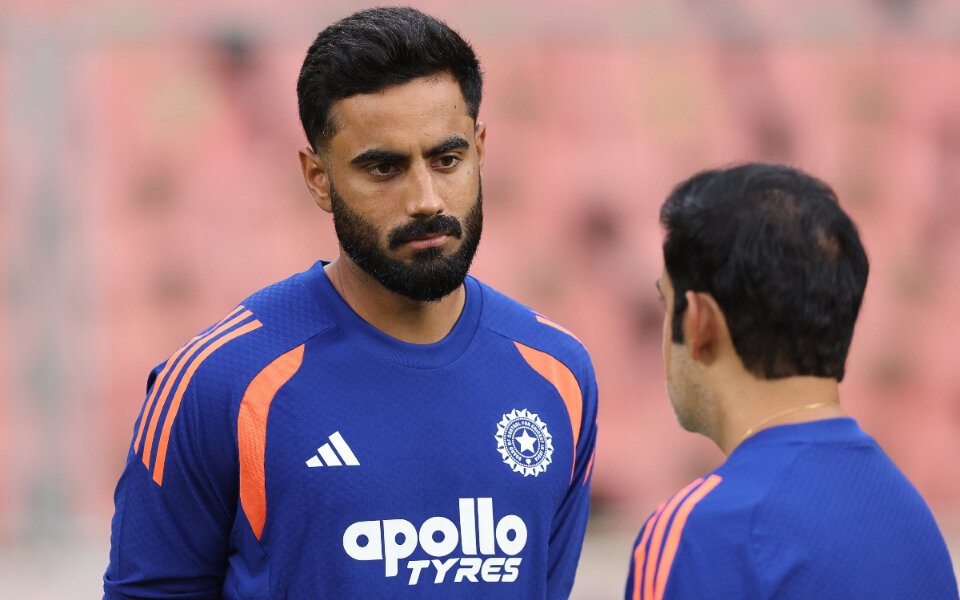
Naman Dhir (Photo Source: BCCI/X) The Indian bowling unit conceded 177 runs during the powerplay phase in the first two ODIs against the West Indies in Thiruvananthuram and Guwahati. The new-ball attack managed just one wicket in the first 10 overs of these games, setting a difficult tone for the rest of each innings. In the second ODI in Guwahati, the West Indies scored 405 runs, a total that reflects the difficulty Indian bowlers face on a batsman-friendly pitch.
Naman Dhir, the right-arm spin bowling all-rounder who made his ODI debut in the series, scored 0 for 38 in 6.1 overs in the Guwahati game before leaving the field due to injury. Ahead of the third ODI on Saturday, October 3, Dhir gave a candid assessment of the bowling performance and outlined the team’s plans for the future. “Yes, as a bowling unit we would like to do better and try to stop West Indies with a lower total.
As you can see, this goal was also good and the floor dimensions on one side were small. Yes, we leaked more clues and could have chosen better plans. But the boost will be bigger in South Africa and that will help the fast bowlers there,” Dhir said in the pre-match press conference.
Bowling performance in the first two ODIs Dhir admitted that the pitch in Guwahati favored the batters and the layout of the pitch posed additional challenges for the bowling attack. He acknowledged that alternative bowling strategies could have limited the opposition’s strike rate, but also pointed out that conditions in South Africa, where the ICC Men’s Cricket World Cup will be held in 2027, would offer pace bowlers other advantages. Dhir was brought into the ODI setup as a replacement for Washington Sundar and was given a dedicated batting and bowling role within the team structure.
The team leadership clearly communicated their role before the start of the series and defined their responsibilities in both disciplines. Dhir used his experience in the Indian Premier League to highlight his familiarity with batting in the middle order. He stressed that his dual role as lower-order batter and reserve bowler was clearly defined and consistent with his previous performances in franchise cricket.
“The communication was very easy: I will bat at number six and seven, where I played in the IPL. Another important role of mine is also to be the fifth and sixth bowler so that the team can use me there and so far that is communication,” said Dhir. Adjusting to the middle order When asked about the adjustment required for his new role in international cricket, Dhir reflected on the mental and technical aspects of the transition.
He noted that although the time frame for batting at the sixth and seventh positions was reduced, his IPL experience had prepared him for such situations. “I think there are not many technical changes. You can make mental changes because you have less time to reach number six or seven.
But I had the experience of playing at number seven in the IPL last season. This is nothing new for me and is not difficult for me. I am there or at the top with my technique,” Dhir added.
Also Read: Abhishek Sharma hits 100 T20 sixes for second consecutive time in 2026. India have already secured an unassailable 2-0 lead in the ODI series ahead of the third match at the Maharaja Yadavindra Singh International Cricket Stadium in Mullanpur. In the series, which is part of the tour from September 27 to October 17, 2026, Shubman Gill led the Indian ODI team against West Indies ctain Shai Hope.