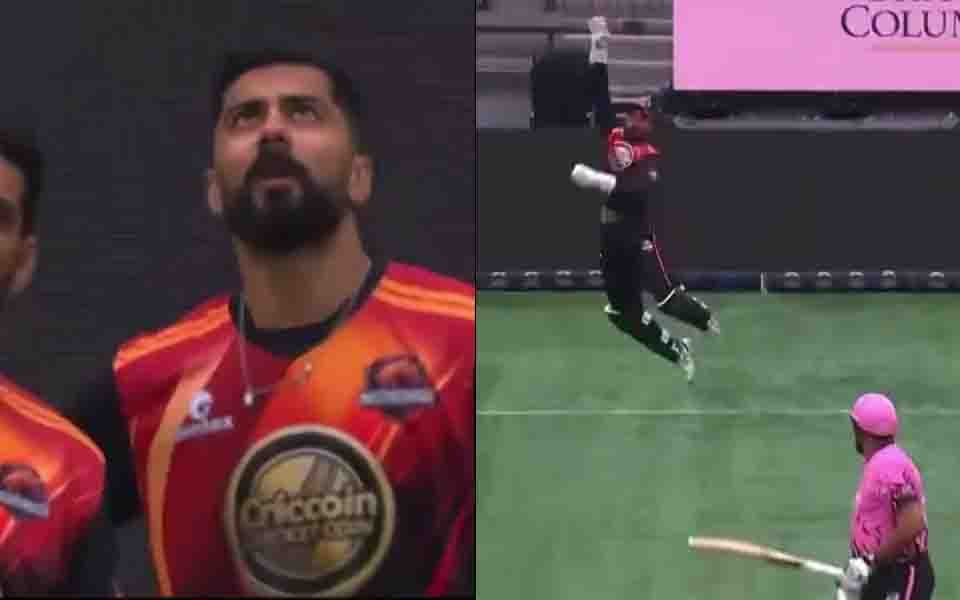
Live Update: Ali Khan’s rebound crosses the line unscathed in the Canadian Super 60 semi-final, the referee signals five runs too wide. The throw went above head height, passed the rope without touching the bat or body and the umpire correctly awarded five runs under MCC Rule 22.
(Source: Canada Super60/X) A performance by Ali Khan in the first semi-final of the Canada Super 60 at BC Place in Vancouver on October 4, 2026 provided one of the most unusual moments in recent cricket. Khan threw a bouncer to Kieron Pollard, who bowled, rose steeply above head height and crossed the boundary rope without touching Pollard’s bat, helmet or any part of his body. The referee responded by finding five discrepancies, a decision that immediately sparked discussion in the comments section and on social media.
“Usually it goes six people, but six people go far.” » said Danny Morrison as he made comments during the incident. The Toronto Sixers won the semifinals by nine points, defending a total of 130/4 in the 10-on-10 contest. This bizarre performance expanded the topics of discussion of a game already distinguished by its compact format and the reduced dimensions of the hall.
Why did the referee call for five wides and not six? According to MCC Law 22, a long throw results in a penalty of one point. Under Law 19, if an untouched rate reaches the limit, four limit rates are added to that one rate penalty, bringing the total to five rates.
No further runs will be awarded beyond this number, regardless of how far the ball travels after crossing the string. A boundary six is only awarded if the ball is hit by the bat and then goes over the boundary. Since Khan’s talk was never touched upon by Pollard, it could not be given a six under any interpretation of the law.
The throw was originally correctly described as “wide” because it was above head height and therefore met the MCC law’s definition of an unplayable throw. The combination of these two rules meant that the referee had no discretion in the matter. The five-wide call was the only legal result, and the short limits at BC Place simply made a rare scenario visible to a live audience.
THIS IS FIRST OF ITS KIND! 😂 pic.twitter.com/y8YtOdHN2k — Usman (@jamilmusman_) October 4, 2026 Can a wide who crosses the line ever be marked as a six wide? The short answer is no.
A wide that crosses the boundary without being touched is awarded five wides, not six, as the laws do not allow a six to be awarded unless the bat touches the ball. This distinction is clear in the law, but is rarely observed in practice, in part because most playing fields have boundaries long enough to prevent an intact bouncer from reaching the rope. Technically, six wides can be on a scorecard, but only if batters complete five wides after the wide is called, resulting in a total of one wide penalty plus five runs completed.
This scenario did not occur on October 4, 2026 at BC Place, where the ball went straight to the edge of the court without being played. “He can’t win six wides, so he can’t have six awards. You need to sort this out, the MCC, don’t you, I think?” Morrison said.
The incident has sparked a broader debate about whether laws should be revised for short-distance indoor locations or for indoor locations where such deliveries can occur more frequently. No formal reviews or rule changes have been confirmed at this time.