
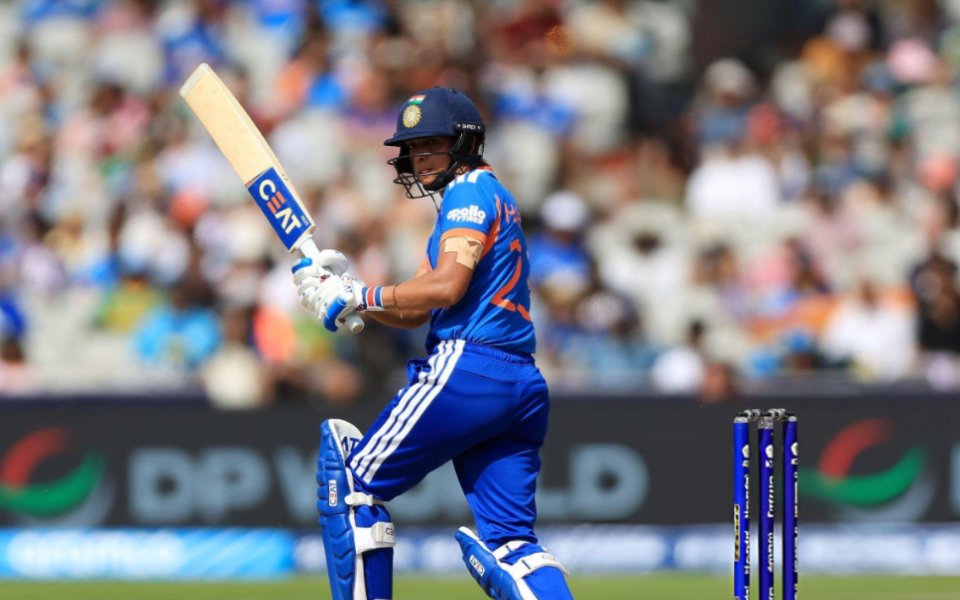
Live Update: The biggest legacy Harmanpreet Kaur will always have as a leader is winning the World Cup, says Anjum Chopra Former India player Anjum Chopra reflects on Harmanpreet Kaur’s ctaincy era and names the 2025 ODI World Cup triumph as her defining achievement.
The biggest legacy Harmanpreet Kaur will always have as a leader is winning the World Cup, says Anjum Chopra (Source: Nigel French/) Anjum Chopra has identified India’s maiden ODI World Cup victory in 2025 as the defining achievement of Harmanpreet Kaur’s ctaincy. The former India player reflected on Harmanpreet’s leadership journey and the transformation of the women’s team under her command. Harmanpreet stepped down from the ctaincy across all three formats this week, with Smriti Mandhana named as her successor.
Anjum, who has known Harmanpreet since a training camp in 2008, shared her assessment in an exclusive conversation on Friday. She highlighted how Harmanpreet’s individual performance and the collective effort of the team shed India’s path to the World Cup title. The 2025 triumph came after India defeated South Africa by 52 runs in the final held in Navi Mumbai.
“The biggest legacy Harmanpreet will always have to her credit as a leader is winning the ODI World Cup in 2025. Look at how her batting shed up in that tournament, in the league games, the semifinal, and the final, and how the team evolved to get there through everyone’s contribution. It wasn’t just Harman.
With every player contributing, Harman was able to lift that crown and India was able to win.” Anjum said as quoted by NDTV Sports. “I’ve seen her grow into that leadership role, and her legacy will always be measured by where she took the reins to where she leaves them. In the one-day format, the Indian team are world champions.
They are a far stronger, more energised, skilful and experienced unit than when she took over,” she added. The evolution of Harmanpreet as player and ctain Harmanpreet ctained India across 5 Tests, 51 ODIs and 155 T20Is during her tenure. Her journey as ctain began in 2012 with a T20I against Pakistan at the Asia Cup in Guangzhou, progressed to permanent T20I ctaincy in 2016, and expanded to include the ODI side in 2022 following Mithali Raj’s retirement.
She assumed leadership across all formats in 2023. “Yes, I’ve seen her from the closest proximity of being a part of the Indian team, even before she became a member at the 2008 training camp, from there to playing her first World Cup match against Pakistan in 2009 till date. I’ve seen Harmanpreet grow as a player, and I’ve seen Harmanpreet grow as a ctain,” Anjum said.
“I have never seen an impulsive side in her. From those days, I’ve always seen a calm demeanour in Harmanpreet Kaur. As a ctain, if somebody makes an ordinary effort in the field, like failing to stop a ball, not throwing it back quickly, or conceding an extra run, she will give that person a go right on the ground, whether the cameras catch it or no,” she added.
Anjum highlighted how Harmanpreet’s leadership and personality shed the Indian team’s proach and confidence. She said Harmanpreet had established herself as the team’s central figure, guiding its growth over the years. However, Chopra felt India’s recent T20 World Cup exits reflected the team’s inability to adt its batting proach across formats.
“You could see it in the proach, body language, and it’s not just with Harman. That goes for any leader in this mould. We’ve had leaders in the past and we will have leaders in the future.
It’s also about an individual’s persona and character. How they are and how they play the sport got reflected in the Indian team as well. It was very evident that this is Harmanpreet Kaur’s team and she is the one who is holding the fort.
I won’t say calling the shots. I’ll say holding the fort. To me, it was very much visible that it was Harmanpreet Kaur’s team,” Anjum said.
“If I have to answer this question about the exits in the two T20 World Cups, I don’t think the team was equipped to handle the opposition. Whether it was in the UAE or in England, we have the same set of players playing both 50-over and T20 cricket, using the same template. Look at the matches closely in the UAE and in England.
I’m not saying only Harman, Smriti, or Dee were scoring, but look at the template and style of cricket,” she added. Anjum stated that India’s inability to replicate their high-scoring proach from the Women’s Premier League in international T20 cricket pointed to gs in preparation, confidence or execution rather than ctaincy. She argued that changing ctains would not guarantee ICC titles, stressing that players must establish and execute the right proach across batting, bowling and wicketkeeping.
“It has to be replicated. If it’s not, that means either the preparation is incomplete, the confidence isn’t there, or you’re unable to execute it for some reason. You can’t be chasing 200-plus in a WPL match and then struggle to reach 150 or 160 convincingly on the international stage.
So it isn’t a ctaincy issue. I could understand blaming ctaincy if tactical decisions were incorrect or if there was favouritism,” Anjum said. “If changing ctaincy guarantees ICC trophies, then change it every tournament.
No harm in that. Nobody would complain, not me, not my seniors, nor the current Indian team. If it meant winning an ICC trophy, we could have a new ctain every tournament.
But the template has to be set by the players, not the ctain. It is set individually by the batters, bowlers, and wicketkeepers, and that is where the Indian team faltered, both in 2024 and in 2026,” she added.
