- Tim Southee backs Bhuvneshwar Kumar to bounce back from his tough T20I comeback. Tim Southee defends Bhuvneshwar Kumar’s recall and early struggles in India’s T20I series against New Zealand and encourages the 36-year-old pacer to perform well in the upcoming matches.
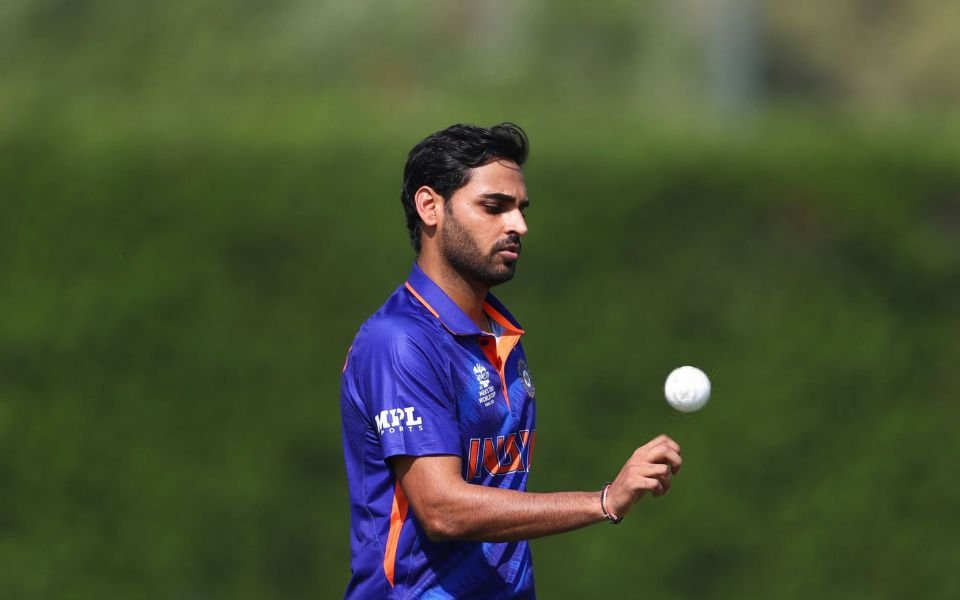
- Bhuvneshwar Kumar (Photo by Matthew Lewis-ICC/ICC via ) Bhuvneshwar Kumar burst onto the international scene after an absence of almost four years, playing in India’s final T20I against the West Indies and the first two T20Is against New Zealand in Christchurch.
- The 36-year-old pacer, who was called into the squad in Jasprit Bumrah’s absence, faced difficult conditions and struggled to find his rhythm during his back-to-school matches.
Tim Southee backs Bhuvneshwar Kumar to bounce back from his tough T20I comeback. Tim Southee defends Bhuvneshwar Kumar’s recall and early struggles in India’s T20I series against New Zealand and encourages the 36-year-old pacer to perform well in the upcoming matches.
Bhuvneshwar Kumar (Photo by Matthew Lewis-ICC/ICC via ) Bhuvneshwar Kumar burst onto the international scene after an absence of almost four years, playing in India’s final T20I against the West Indies and the first two T20Is against New Zealand in Christchurch. The 36-year-old pacer, who was called into the squad in Jasprit Bumrah’s absence, faced difficult conditions and struggled to find his rhythm during his back-to-school matches. His first two pearances against the Kiwis brought modest returns: 4 overs for 49 runs without a wicket in the first game, followed by 4 overs for 50 runs with a single dismissal of Daryl Mitchell in the second T20I at Hagley Oval on Saturday.
“You look at his skills and experience, which is crucial in the absence of Jasprit Bumrah,” Southee told HT. Why did Bhuvneshwar struggle in his first few games? The Christchurch pitches offered batting-friendly conditions, which was particularly evident in the first T20I where India scored 226 runs.
Southee attributed some of the bowling difficulties to the nature of modern white-ball cricket and the surfaces on offer. He explained that the lack of swing action at the start of the innings forced bowlers to rely on alternative skills rather than traditional seam-based proaches. “Yes, it’s interesting.
You see a bit of swing in the first over but I think that’s been the case in white-ball cricket for a while – the ball hasn’t swung,” Southee said. How will Bhuvneshwar be used in the series? In the second T20I, Indian ctain Shreyas Iyer used Bhuvneshwar mainly during the powerplay phase.
His third over of this period lasted 17 runs, reflecting the difficulties he faced in containing the New Zealand batters. Later in the innings, Bhuvneshwar was asked to bowl the 16th over where he conceded 18 runs. In the first T20I, he won the final which lasted 14 runs.
“As a bowler you have to be flexible and adtable. I think the inclusion of Prince Yedav probably killed that a little bit,” Southee said. What challenges exactly does Bhuvneshwar face?
One of the statistical problems in Bhuvneshwar’s first two games is his control with the new ball. He bowled five long balls and three no-balls in the two matches, a remarkable development considering he had never bowled a no-ball in his previous 88 T20Is before this series. Such failures highlight the adjustment challenges he faces after such a long absence from international cricket.
A seasoned campaigner with considerable experience, Bhuvneshwar will have to use his mental reserves and technical knowledge to turn the tide in the remaining games of the series. The international format requires a different level of intensity and precision than domestic league cricket and his ability to recalibrate will be crucial to his contribution to the Indian campaign.